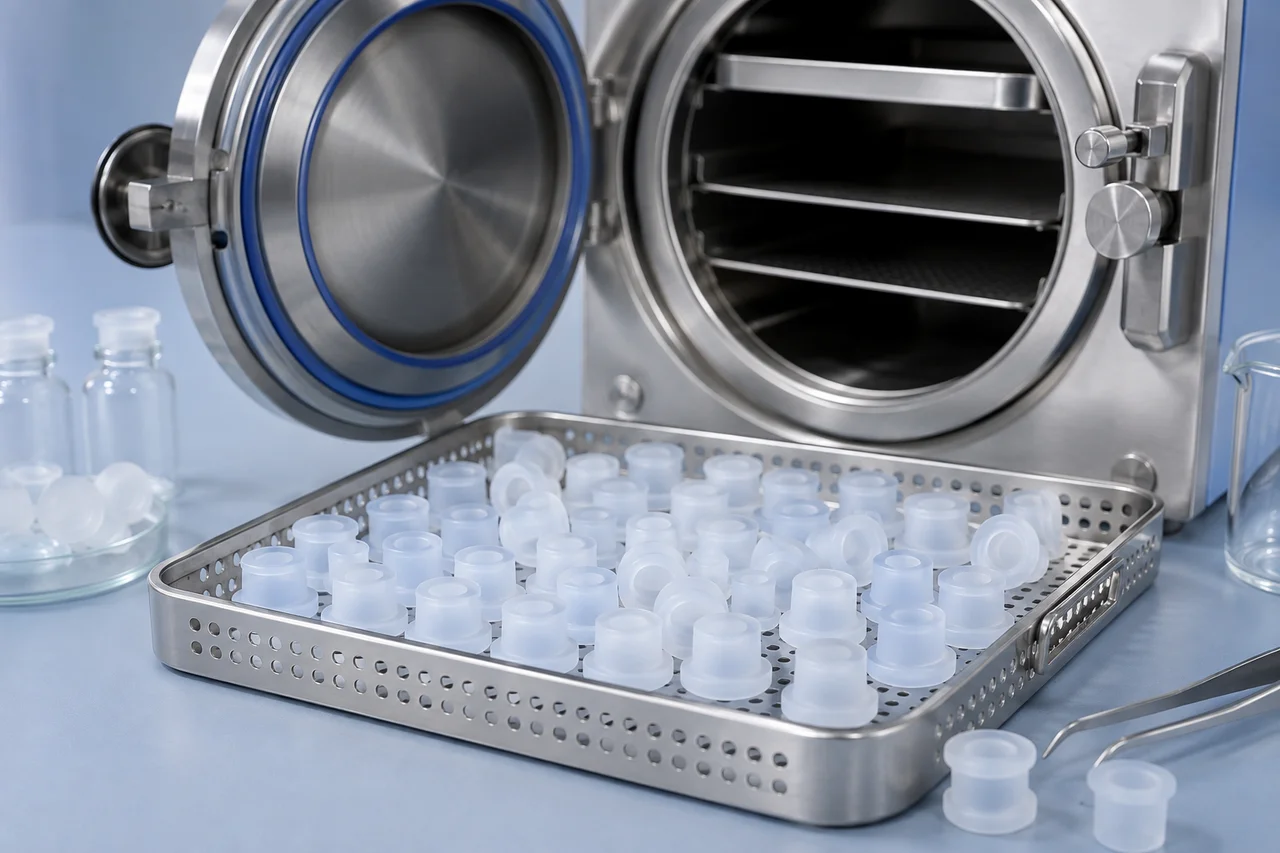
Begin with the processing instructions for the exact stopper grade. A material name alone does not define a suitable sterilization cycle: compound formulation, surface treatment and packaging can all matter.
For products approved for moist heat, steam sterilization requires a validated process. Load configuration, packaging, steam access, temperature and exposure time must work together. Selecting a temperature on an autoclave does not, by itself, demonstrate successful sterilization of the load.
Irradiation also needs material-specific evaluation. A stopper can retain its shape while its elasticity, piercing behavior or extractables profile changes. For presterilized components, check the supplied processing status, package integrity, storage conditions and use period.
Three terms need to remain distinct:
- Cleaning removes residues and reduces contamination associated with them.
- Sterilization addresses viable microorganisms through a validated process.
- Endotoxin control requires its own suitable strategy; sterilization does not automatically establish endotoxin removal.
After processing, assess the properties relevant to the application. These may include cracking, sticking, dimensional change, sealing and piercing performance. Repeated processing requires evaluation of cumulative exposure, rather than an assumption that a cycle can be repeated indefinitely.
Household boiling and alcohol wiping should not be treated as substitutes for validated sterilization. If the supplier cannot provide suitable processing information for a general-purpose stopper, obtain that information before selecting a method.
← Back to all articles