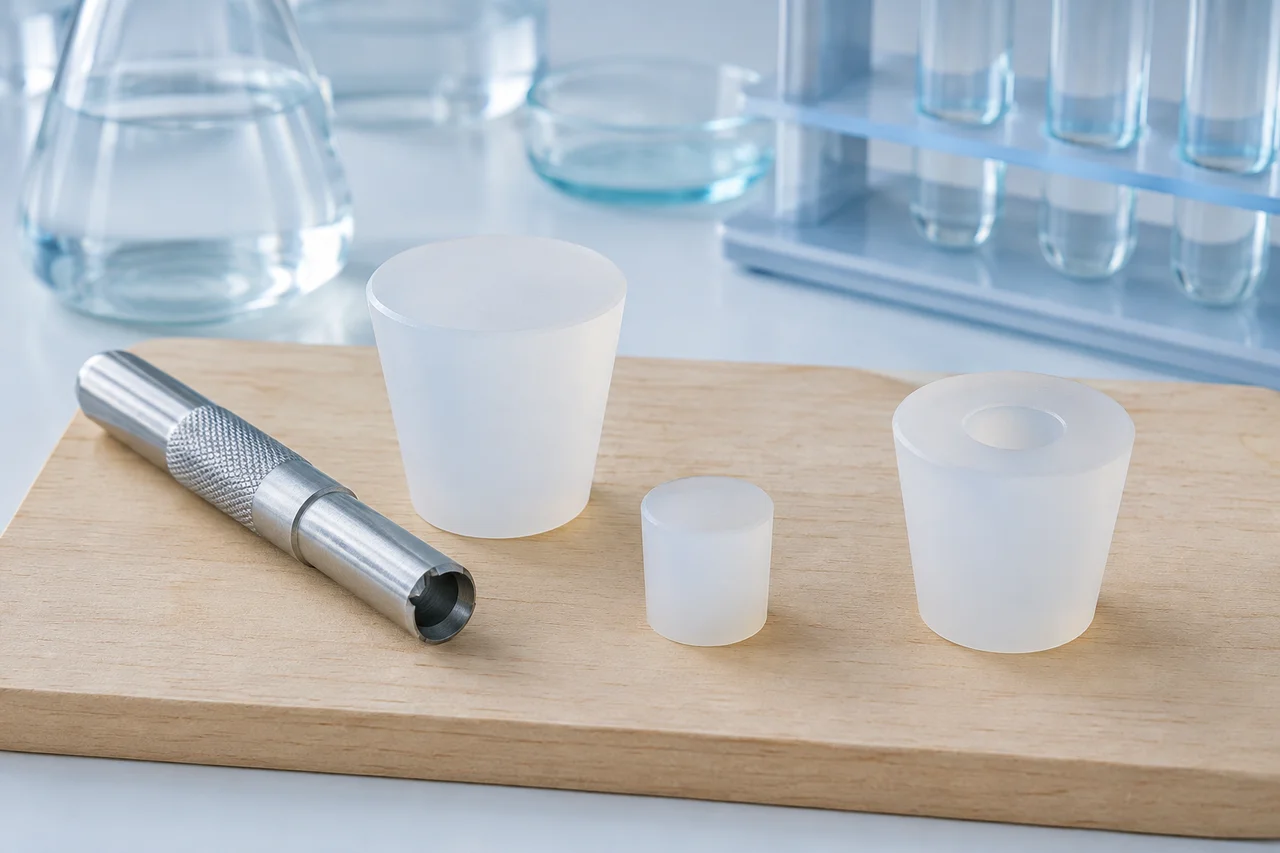
Rubber deforms during cutting and recovers afterwards. Consequently, tool diameter alone does not establish the finished bore or the assembled fit. A hole that accepts a tube may still have a torn wall that leaks.
For a few general laboratory components, an appropriate sharp hollow stopper borer can be useful. For repeated use or tighter requirements, consider predrilled products or manufacturer-controlled processing. Do not modify a pharmaceutical piercing closure and assume its original qualification still applies.
Before cutting, establish the tube diameter, hole position, remaining wall thickness and required fit. With multiple holes, leave adequate material between bores and around the outside edge. Thin sections can tear during assembly.
Support the stopper securely on a suitable sacrificial board, never on the palm of a hand. Keep hands clear of the cutting edge and its exit path. Rotate the borer slowly while maintaining alignment. Cutting partway from one side and finishing from the opposite side can help reduce damage at the exit.
An ordinary twist drill may grab or tear a soft compound. Burning a hole offers poor control of the surface and is not a suitable general method.
Remove loose fragments after cutting. Inspect for an off-center bore, cracks and ragged edges, then trial-fit the intended tube. Where sealing is required, assess the assembled interface rather than accepting the part solely on nominal hole diameter.
← Back to all articles